Hair Transplantation
Natural Hairline Design in Hair Transplantation
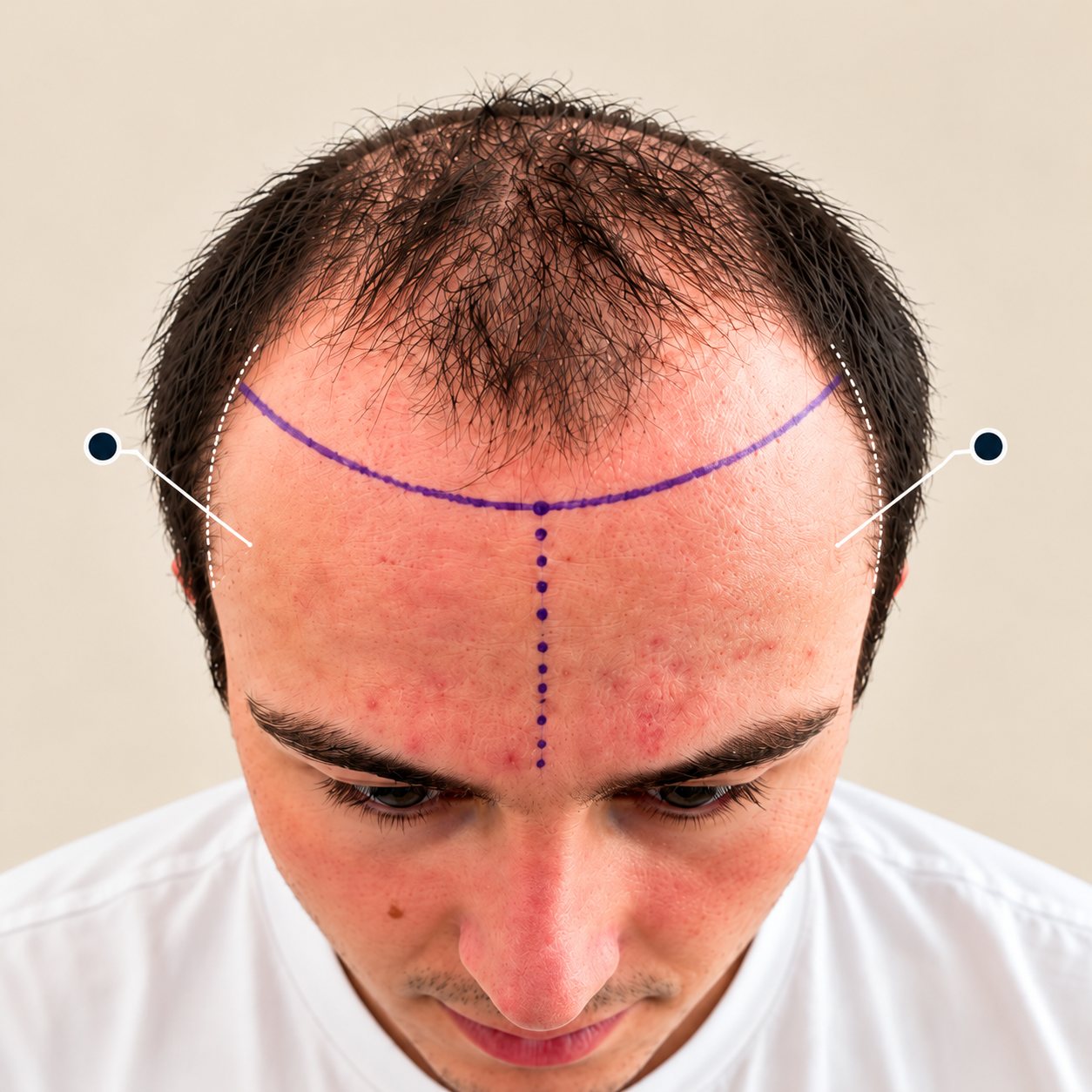
Designing a hairline is not simply a matter of drawing a new line across the forehead. Facial proportions, forehead height, age, the existing hairline, natural growth direction, donor capacity and future hair loss should all be considered together.
What Should a Natural Hairline Look Like?
A natural hairline is not perfectly straight or geometric. It should include subtle micro-irregularities, natural exit angles, a gradual increase in density from front to back and a soft leading edge created mainly with single-hair grafts. Depending on the individual face, the overall shape may be straighter, oval, gently V-shaped or curved.
Should Everyone Have the Hairline at the Same Height?
No. Facial length, forehead height, eyebrows, temples, existing hair and donor reserve all need to be considered.
Can the Hairline Be Lowered Significantly?
Technically this is possible in some patients, but an unnecessarily low hairline consumes a large number of grafts, reduces the donor reserve and may look less natural as the patient gets older.
Why Does Age Matter?
Hair loss may continue to progress in younger patients. A more conservative, long-term approach is therefore particularly important.
Facial Proportions
The hairline influences the upper third of the face. Rather than relying on a single mathematical measurement, the aim is to create natural balance.
Male and Female Hairlines
A male hairline may be more angular and age-appropriate, whereas a female hairline is often softer and more rounded.
Single-Hair Grafts
Single-hair follicular units are used predominantly at the leading edge to create a softer, more natural transition.
Micro-Irregularity
Controlled, millimetre-scale irregularities help prevent a ruler-straight or artificial appearance.
Growth Angle
Frontal hairs often emerge at relatively low angles, and temple hairs can grow at even more acute, almost horizontal angles.
DHI or Sapphire FUE for the Hairline?
A natural hairline can be created with either technique. DHI can offer practical advantages in delicate areas and when working between existing hairs.
Hairline Density
The very front should usually look softer and lighter, with density increasing gradually behind it.
Graft Consumption
Lowering a hairline by 1–2 cm can consume a substantial number of grafts, particularly across a broad forehead.
Temple Design
The temples are among the most technically sensitive areas because the hairs are finer and grow at very acute angles.
Forehead Reduction
In patients with a naturally high forehead, hair transplantation can be used to create a lower hairline and reduce the apparent forehead height.
Can a Poor Hairline Be Corrected?
In selected cases, additional grafts can be used to soften, camouflage or redesign an unnatural previous hairline.
Symmetry
Perfect mathematical symmetry can itself look unnatural. The aim is balanced, natural harmony rather than mirror-image geometry.
Common Hairline Design Mistakes
- A hairline positioned too low
- A completely straight line
- Multi-hair grafts placed at the very front
- Angles that are too upright
- Incorrect temple direction
- Ignoring long-term donor reserve
Final Design on the Day of Surgery
The definitive hairline is agreed with the patient on the day of the procedure.
Can the Hairline Be Designed from Photographs?
A preliminary design can be discussed from photographs, but perspective and lens distortion mean the final line should be confirmed in person.
Message us for a free preliminary assessment
Send your photo via WhatsApp and we'll get back to you with a physician's assessment on suitability and planning.